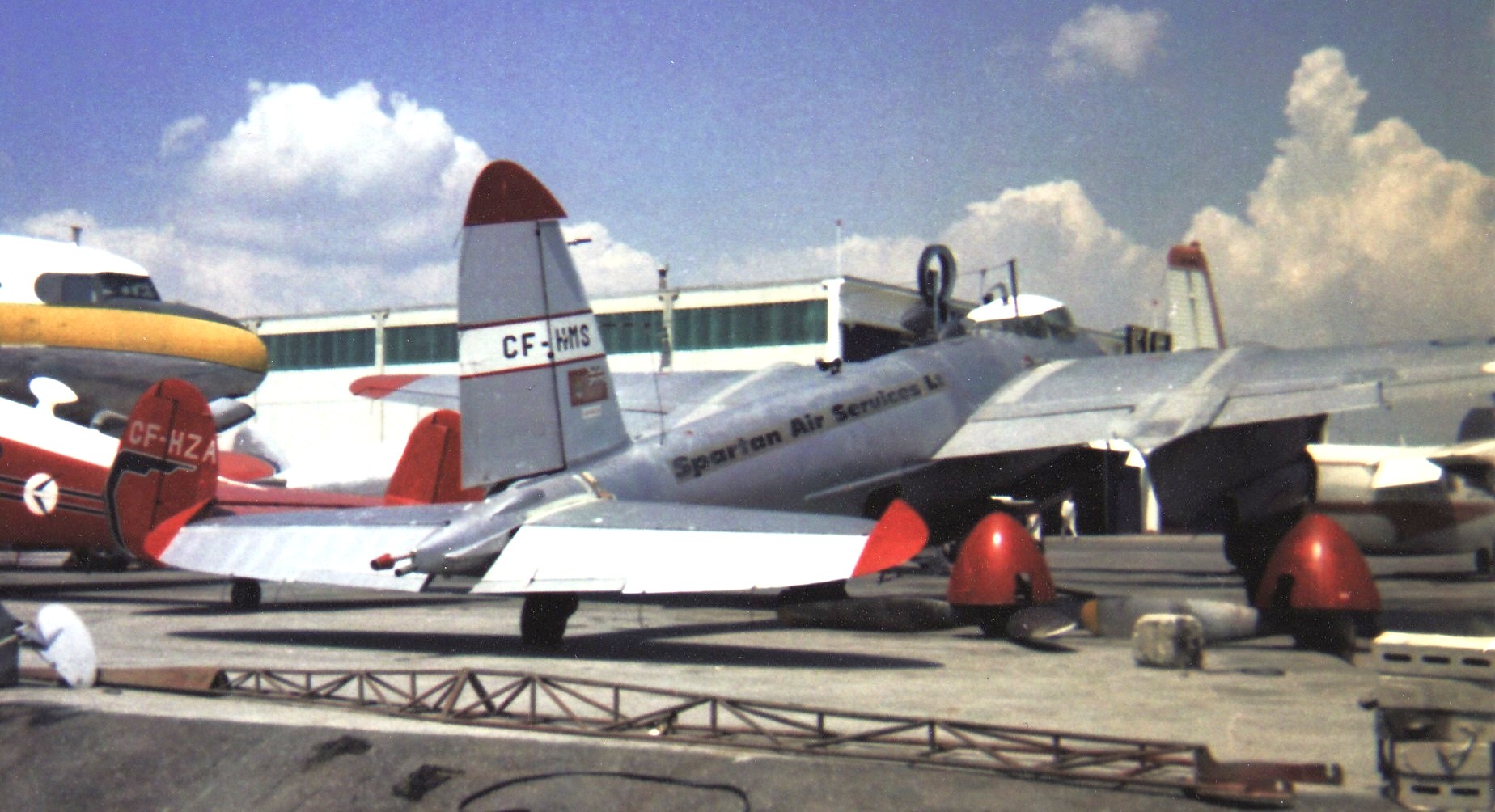
Click on any image for a slideshow!

The 'Will It Ever Stop Snowing?!?! First Quarter Report From the Calgary Mosquito Society
Welcome to our third false spring and fourth winter of 2026. Despite Mother Nature's best efforts to keep us indoors and persuade us to leave our snow tires on forever, our hearty volunteers still made their way down to the Bomber Command Museum to put in 1377.75 hours since January 1. Yea you!
Cool stuff on the go: Milestones reached. Also, we are back to a Tuesday work day again. How and why you ask? Read on for answers.
Hurricane
We met with our City of Calgary Civic Partnership Consultant, Sean Roach on February 24 to discuss the future of the Hurricane, specifically, if and where it may continue to do engine runs. Our contractual obligation to the City is to restore both the Hurricane and the Mosquito to 'run and taxi' status; a decision made by City Council and written into our contract with them.
For the past couple of years, the Hangar Flight Museum has expressed its concerns and reluctance to do engine runs with the Hurricane once we reinstall the running engine and prove that we have a 'run and taxi' airplane by actually starting it up. At the conclusion of the first run, the Calgary Mosquito Society will have fulfilled all of its contractual obligations with the City, and our work on the Hurricane will be complete. And as much as that is true, we have also offered to the City, and to the Hangar, to create a team to continue to maintain and run the Hurricane at the Hangar Flight Museum. We'll keep you posted on developments.
Mosquito
There has been a real push on sourcing parts as our cockpit specialist Andy W. forges ahead with his research into what radios and navigational equipment Spartan used in the Mosquito. Andy has identified 106 pieces, of which we have found, sourced, or purchased 49 to date. An additional 14 may be within reach, leaving 43 yet to be acquired. Our hosts at Bomber Command have generously turned over several pieces from their loft of treasures, at no cost! Big thanks to them.
Andy and I have been utilizing eBay extensively with radio, nav and intercom pieces coming from Greece, Austria, the UK and the USA. Some sellers in the US will not ship to Canada, so we needed to set up a drop location in the States. Our thanks to member Hugh Gilchrist, who happened to overhear our conversation and immediately jumped in with a solution for us. Yahoo and yea Hugh!
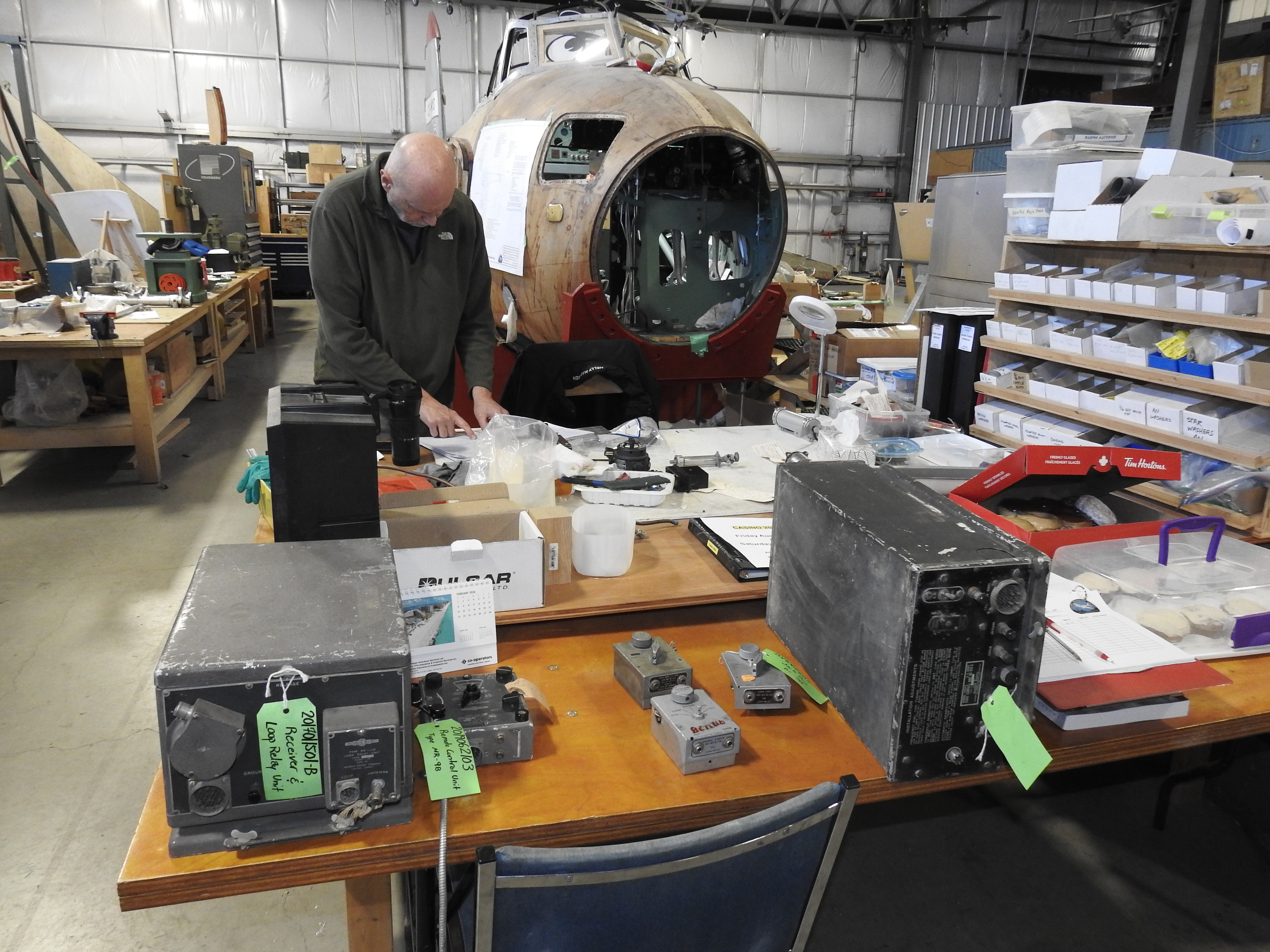
The six pieces on the table were all acquired from the Bomber Command Museum’s ‘cave of wonders’. We were simply told to go look for ourselves, put any relevant pieces in a pile, then check with their Lanc guy, Dr. Brian Taylor to see if he needed them, and if not, they were ours. Amazing how easy it can be when organizations work together. Big thanks to their curator Karl Kjarsgaard for the great support and cooperation.
We have also spoken to Suzanna S. at the Hangar Flight Museum, and are awaiting the warmer temps of May for the chance to go through some of their storage cans looking for parts that fell off our airplane over the years.
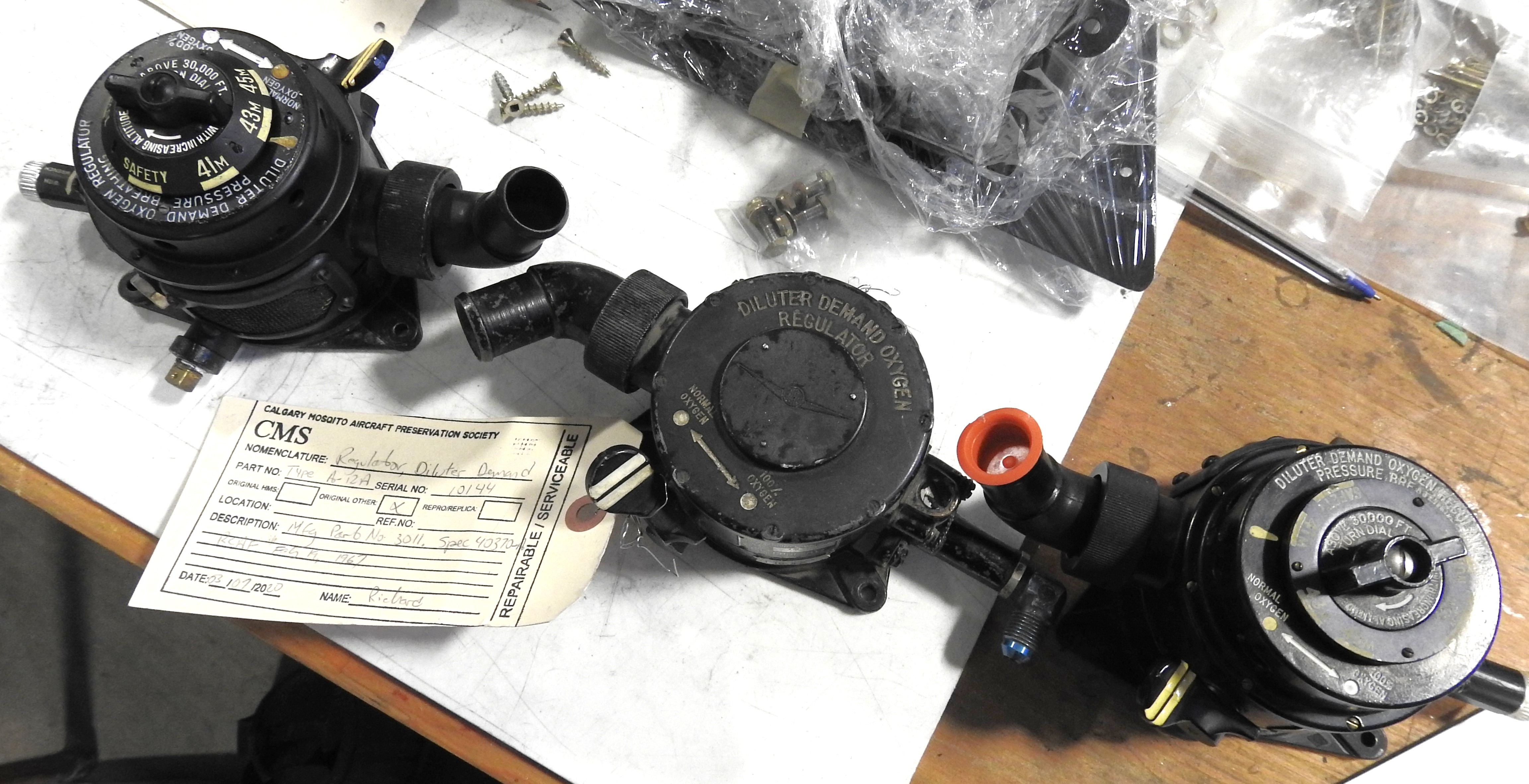
Some NOS (New Old Stock) A-14 oxygen regulators purchased by Andy off eBay from Greece. We had a number of A-12s, such as the one in the center, but being the picky buggers, we are, we wanted the authentic A-14s. Who would have known the difference? We would have known.
Andy has put together a comprehensive shopping list and we will be distributing it to museums across Canada via the national association of aviation museums, CAPA, with fingers crossed that they can take the time to read it over and scan their collections.
Jack McWilliam
This first report of 2026 includes a number of significant milestones; the first being a very significant one for myself. As Richard pointed out, I am now 'unemployed' (retired) after 54 years of caring for active aircraft. With that in mind we will up the amount of time spent working on our aircraft. At the start of Covid, we were asked by the Bomber Command Museum to not continue our Tuesday afternoon and evening work on the Mosquito, as Tuesday evening was also the project night for their people, and our being there exceeded the number of bodies allowed under Covid regulations. We will now add Tuesday afternoons and evenings, back to our work schedule for the Mosquito.
Gary T. and Dick S. finished attaching the last of the thirteen new skins to the upper wing surface in late March.
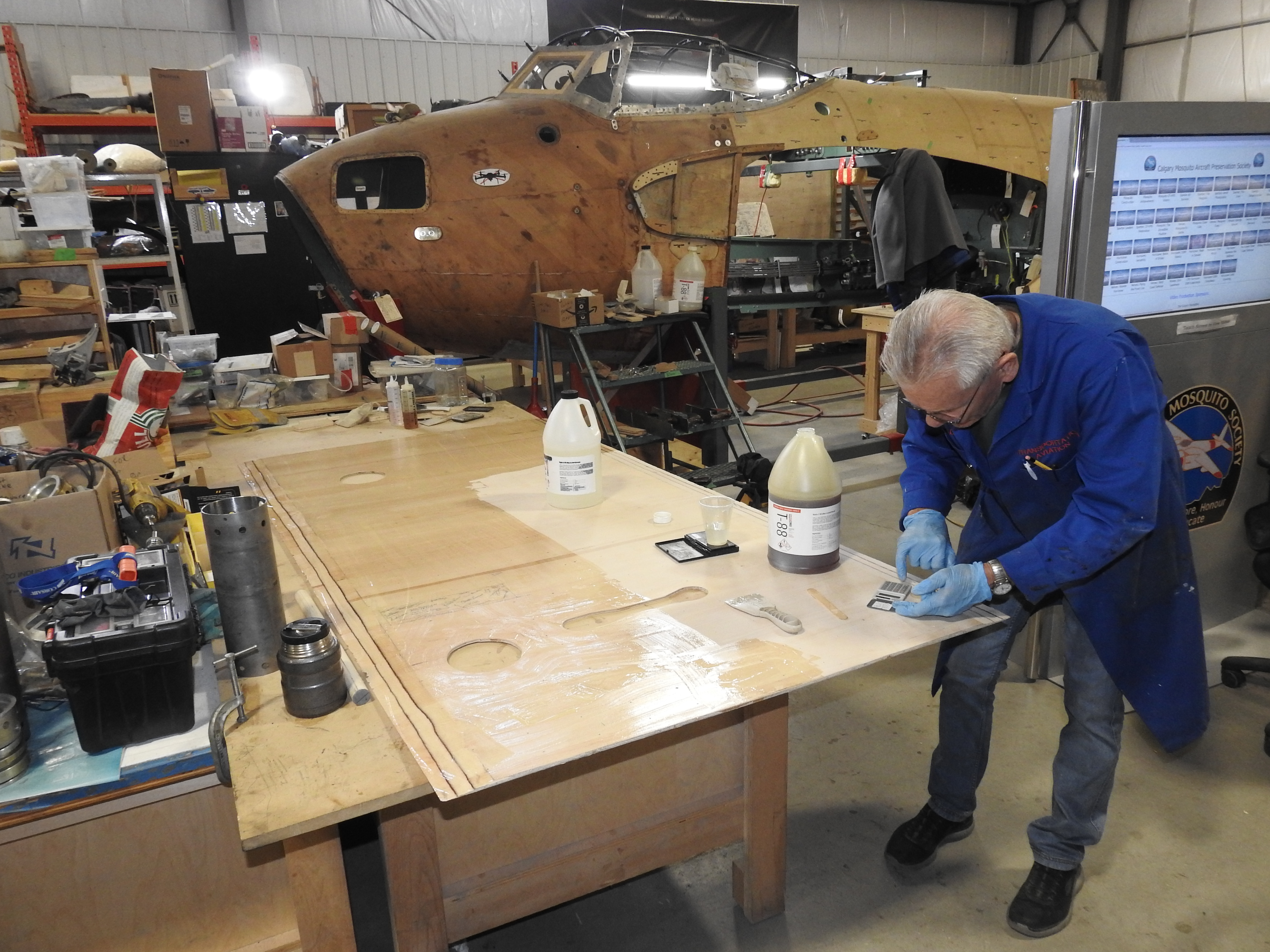
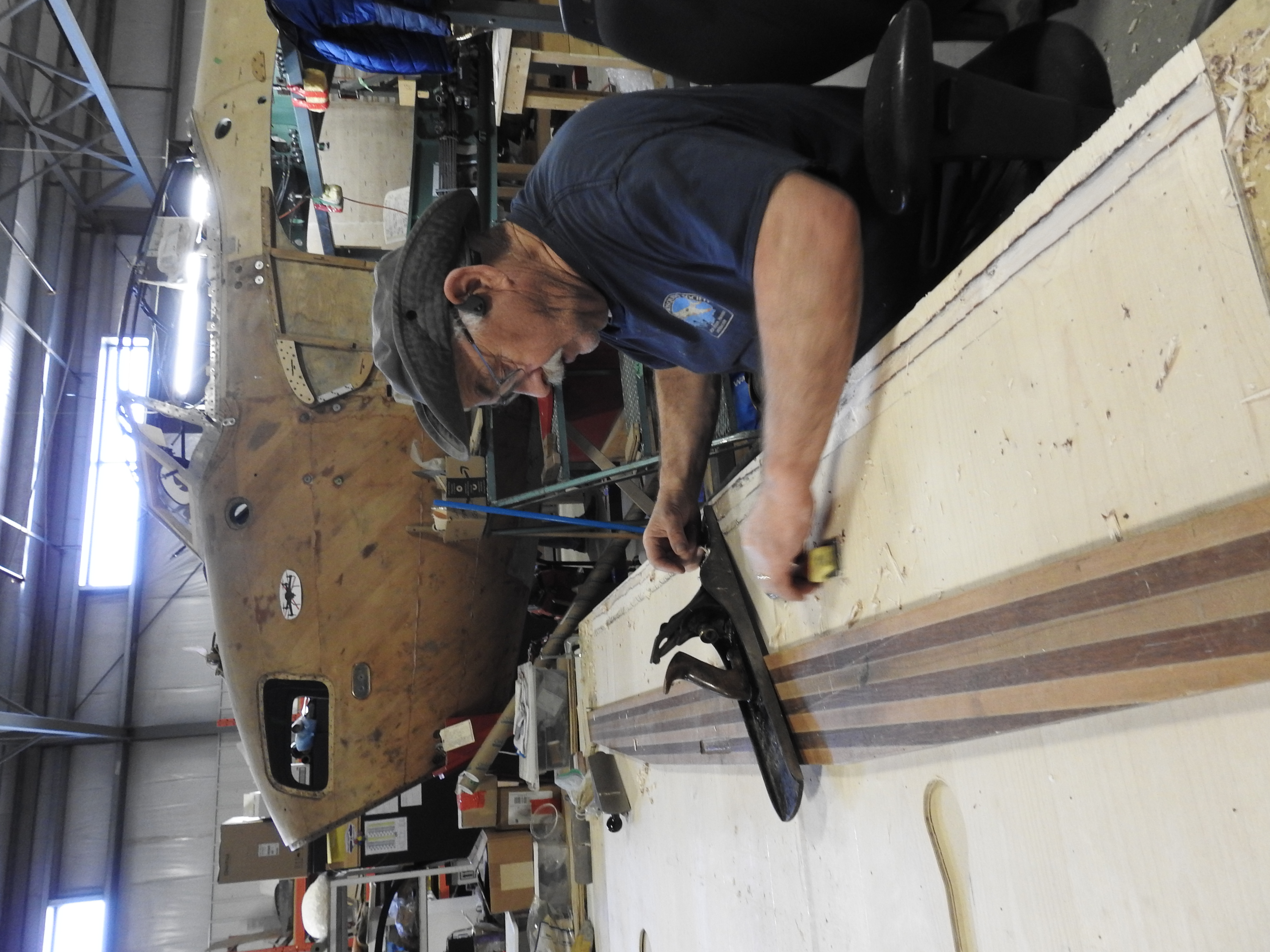
Above, Dick S. applies T-88 adhesive to the last new upper wing skin, while below, Gary T. bevels the edges to overlap the sheets on either side of it.
The first new skin was installed three years ago, on March 4, 2023. It remains for our crew to remove staples and puck board from the scarfed edges, and then pull out all the steel screws, replacing them with brass and then filling and sanding the holes.
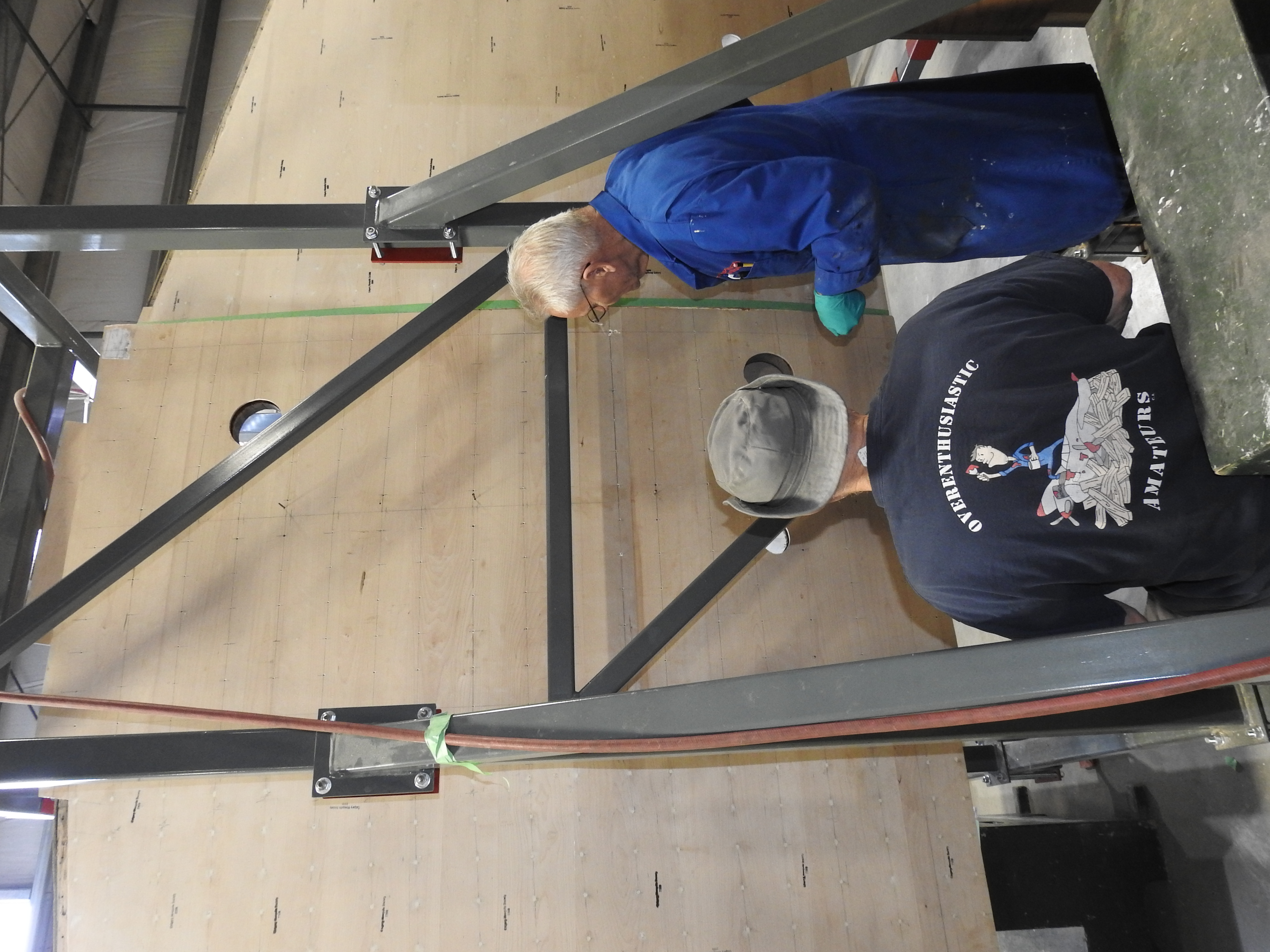
Our wood masters, Gary T. and Dick S. install the last new top wing skin, in a project that has been ongoing for three years. Next, it's new trailing edges.
Quite a number of volunteers have put their DNA, sweat and tears into the skin installation after Gary removed the old skins. Scraping old paint, uncovering buried treasures in the way of pencil notes, stencils and scribbles, and repainting the structure before the new skins were installed. It's not been glamorous, but we want to acknowledge all the work that they have contributed.
Not to be a killjoy but there still remains a large amount of work on the top surface of the wing, such as the engine nacelle fairings, and reattaching the skin to the internal ribs with three-inch, #4 BA screws. We also need to reinstall the main fittings for the wing to fuselage attach points, as well as an assortment of electrical boxes to the top skin of the center section, which when assembled, becomes part of the rear cockpit area.
In the up coming weeks, we will also be shifting our attention to the wing's trailing edge structure for rebuild and attachment. Andy W. got a good start on this last year by locating and laying out the pieces on a series of connected benches; the full length of what is left of the port and starboard trailing edges. And it's not pretty. Both sides suffered very badly from having been left outdoors when the airplane was sent to Cold Lake in 1989. We will start with the port side trailing edge, as by happenstance it is closest to the front of the work benches. The benches holding the trailing edges are along side the fuselage and are taking up a lot of floor space. It will be nice to have the trailing edges finished, reinstalled and benches removed, allowing us to reclaim some walking and working space.
Joe M. and gang should be ready to go with the installation of the starboard side metal attaching fixtures to the rear spar, as Dick S. installed the walnut plates on the aft spar. Gary T. is currently carving a couple more walnut parts for install of the gear attach points on the aft spar.
Michael H. continues to ready the wing fuel bays for more component installation, going over all the pictures taken before we started stripping them out several years ago.
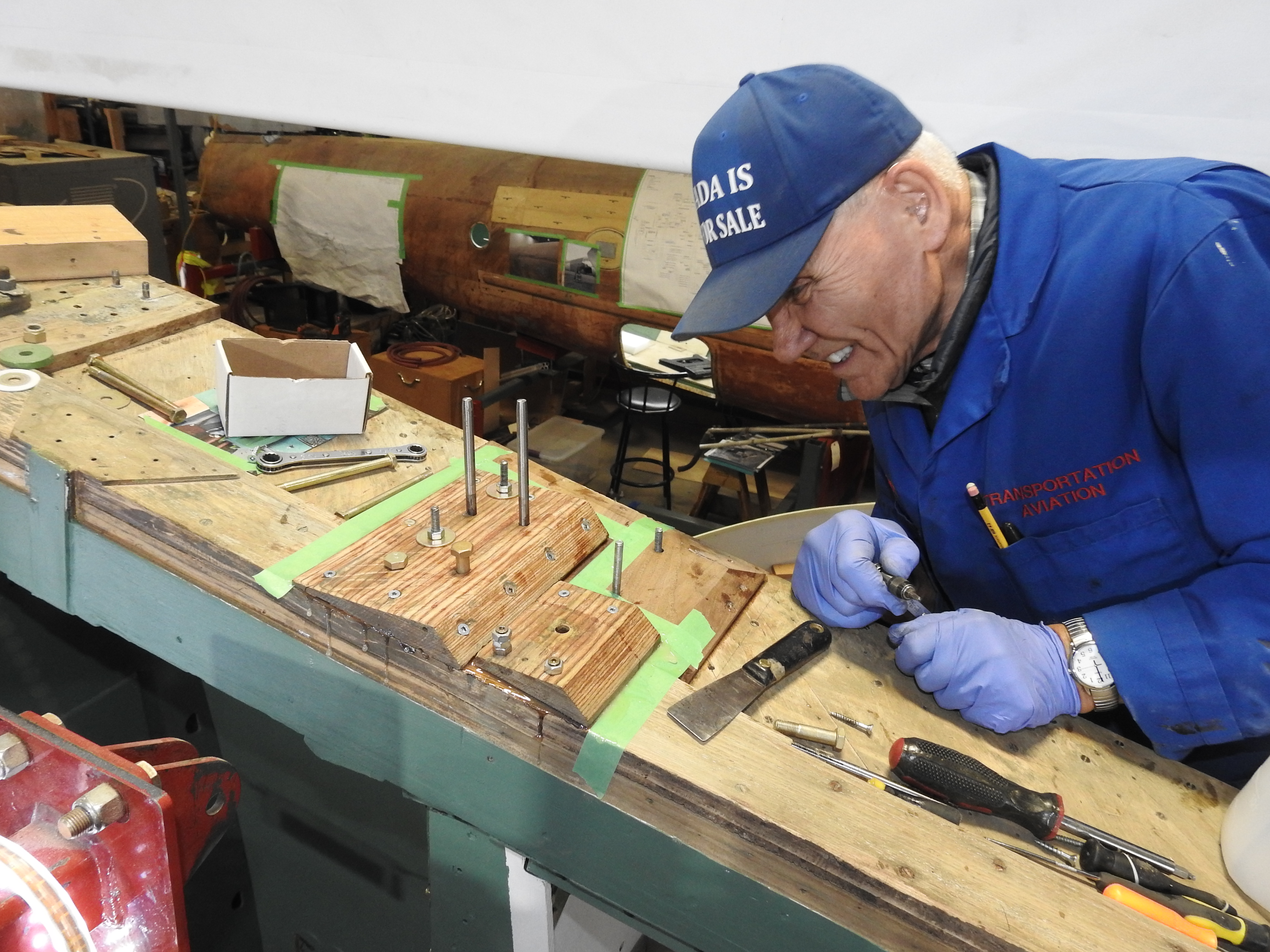
Dick S. attaching the walnut plates to the rear wing spar. The metal attaching fixtures then get mounted on the walnut plates.
Part of the challenge is also locating all the parts we stripped out. Despite having crates built and numbered for each fuel bay, not all the parts made it from bay to box...Grrr! As Michael scours shelves, boxes and benches for all the parts, we will do a temporary installation with them, while others get repaired. Then it's off to Cam B. and the paint shop for final finishing before the parts go back in for good.
Alan W., Colette P. and gang continue on more pneumatic and hydraulic line cleaning and inspecting -another unglamorous job that seems to never end. A number of these lines are badly damaged due to internal moisture freezing and then splitting the lines. At least we have the end fittings for a lot of them and can use those on new lines where necessary.
As detailed in the intro, Richard de B. and Andy W. are going down the long and winding road of sourcing radio and navigation equipment. As we continue to empty our parts crates to reinstall equipment into the airplane, we learn more and more about what we are missing and what we need to source - a challenge that will be with us from now until the day we finish the airplane.
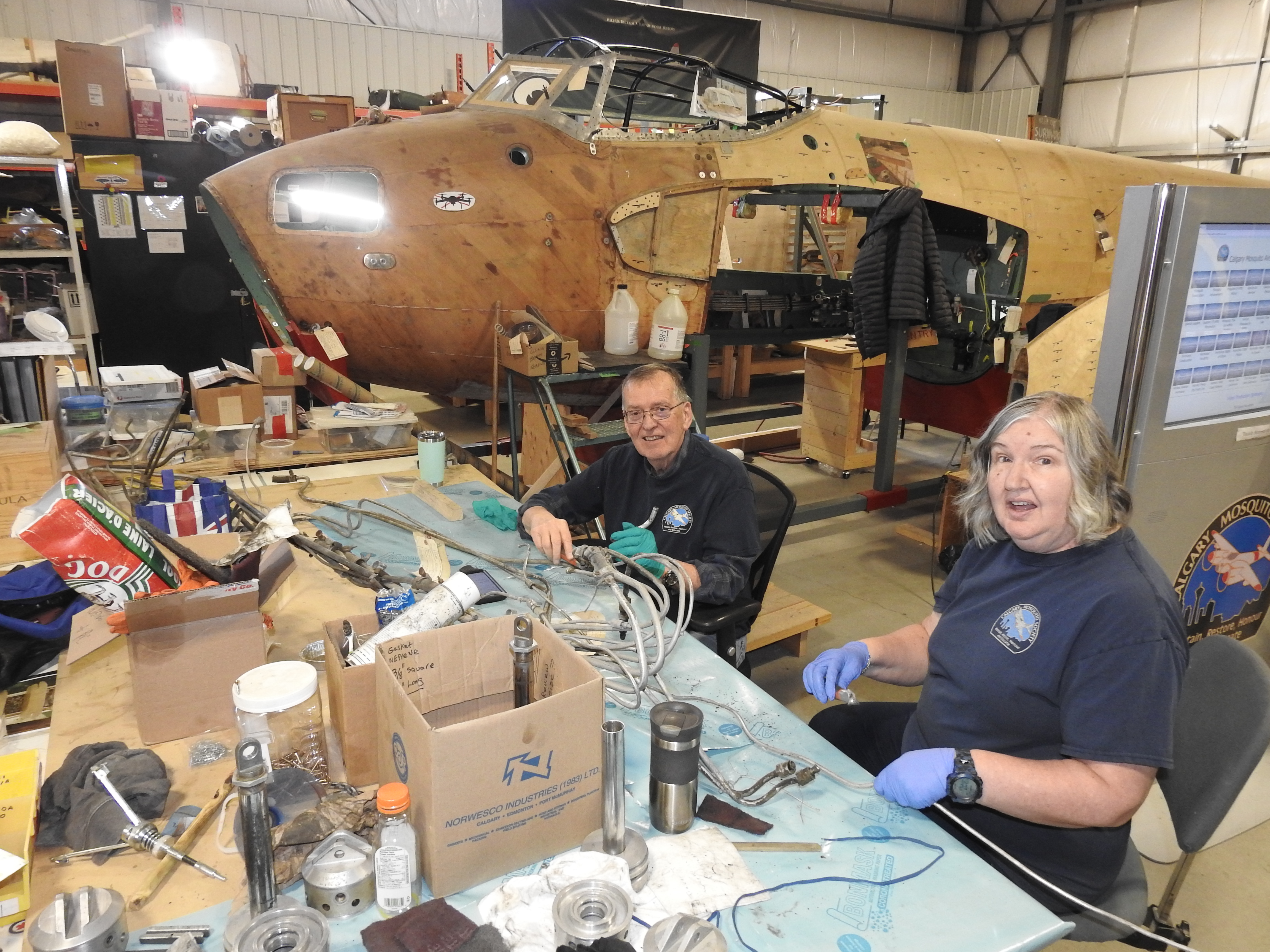
Alan W. and Colette P. continue the glamorous work of cleaning up endless lengths of hydraulic and pneumatic lines.
Don H. is running landing gear parts for Davy D. to the paint shop. Once those are back, Davy can reassemble the side stay rods and uplocks. The axle caps and bolts were recently 'rediscovered' and then refinished. With the first main landing gear near completion, our undercarriage boss, Jaime G., is starting to take stock of the second set of compression struts and looking to repeat the whole process.
In addition to running parts for welding, powder coating and bead blasting, our rear fuselage boss, Don H. is busy on Tuesdays and Saturdays hooking up flight controls, namely the trim cables. It is not an easy task the first-time round, so a certain amount of smoke is occasionally detected coming from that corner of the shop.
Trevor J. is making the overhaul of the flap actuators his life's work, but is making good progress in gaining an understanding of the internal make up. We have secured a vendor to grind and hard chrome the actuator rods.
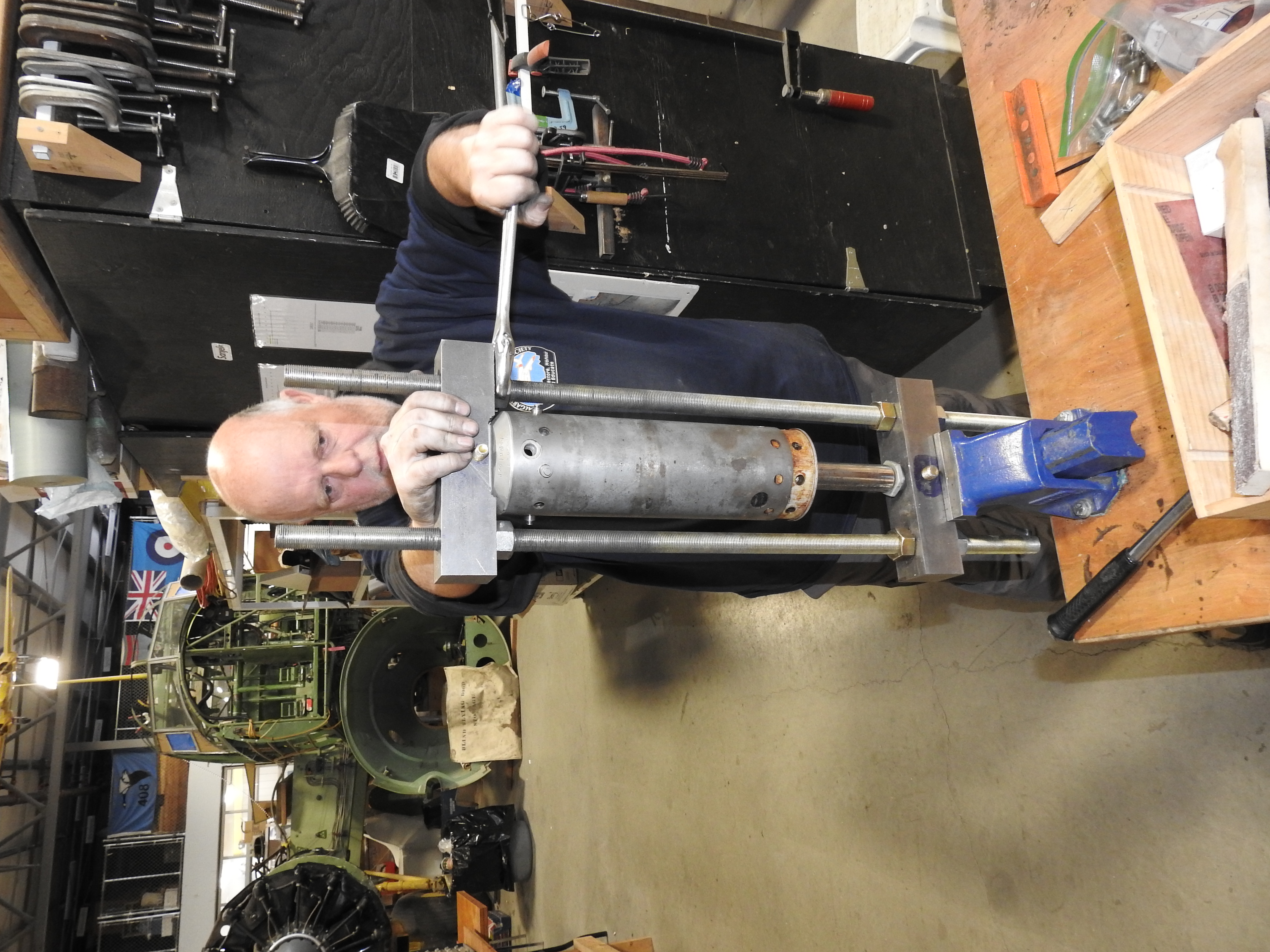
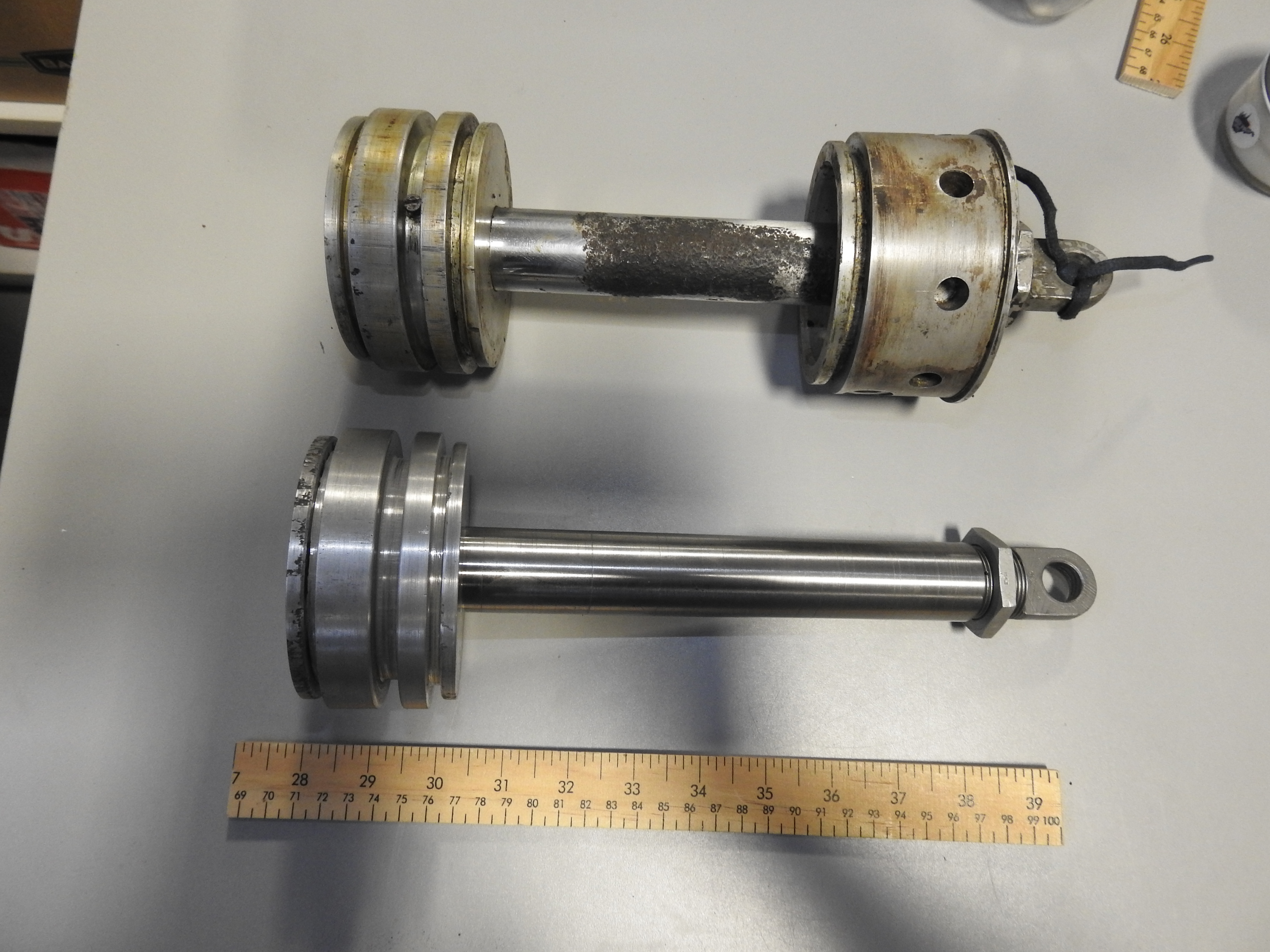
Trevor J. hard at work disassembling one of the flap actuators. Below, a sort of ‘before and after’ look at the piston and shaft. The shafts will have to be re-chromed.
The barrels are badly corroded and might not be salvageable, but I am still looking for a coating solution for these components. We are very fortunate in having half a dozen actuators from which to pick parts, but sadly all are suffering the ravages of time and oxygen exposure, turning them a tell-tale reddish-brown colour.
I want to touch base on some details that most people won't see, and some may not appreciate in terms of what goes into some component work and restoration on this job. We have all watched Gary T. painstakingly develop a process to remove then install new skins on the wing. At the same time, Dick S. has been working on various small tasks that may look minor or insignificant, like removing dents from conduit, but as he does some of this work in his shop at home, no one sees the jigs and bullets he has designed in order to accomplish these tasks. His skill and patience are beyond measure.
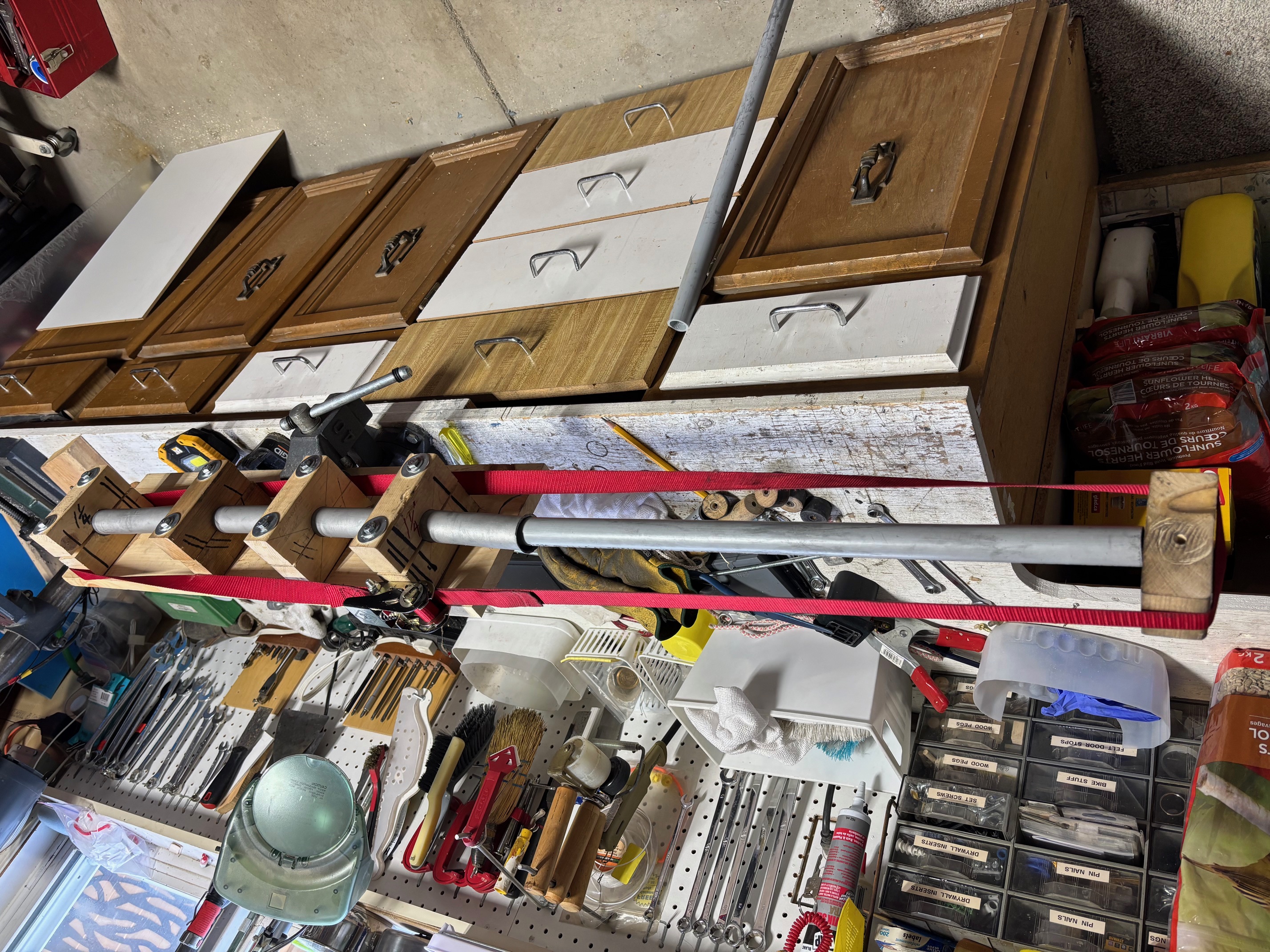
Dick S's workshop at home where he has designed and built a jig and bullets for removing dents from metal conduits. Photo Dick S.
Michael H. has invested many hours scrubbing very tiny straps for use in securing the aircraft wing into position, and yes, it would be easier to make new ones, but those wouldn't be original and authentic, having the de Havilland part numbers or markings.
Gary T. is also busy working on several projects at home, to be used back on the aircraft in weeks to come. Notably, he has utilized his machining skills and tools to design and manufacture pin pullers to disassemble the flap actuators, all of which requires considerable brain power, the equipment to accomplish the job and the will, skill and time to do so.
When time and manpower allow, we lend a hand to our hosts, putting some of the young folk to work their Merlin 68 project, while Gary T. helped rebuild a rear Lancaster nacelle and I chipped in with some spraying in their new paint booth.
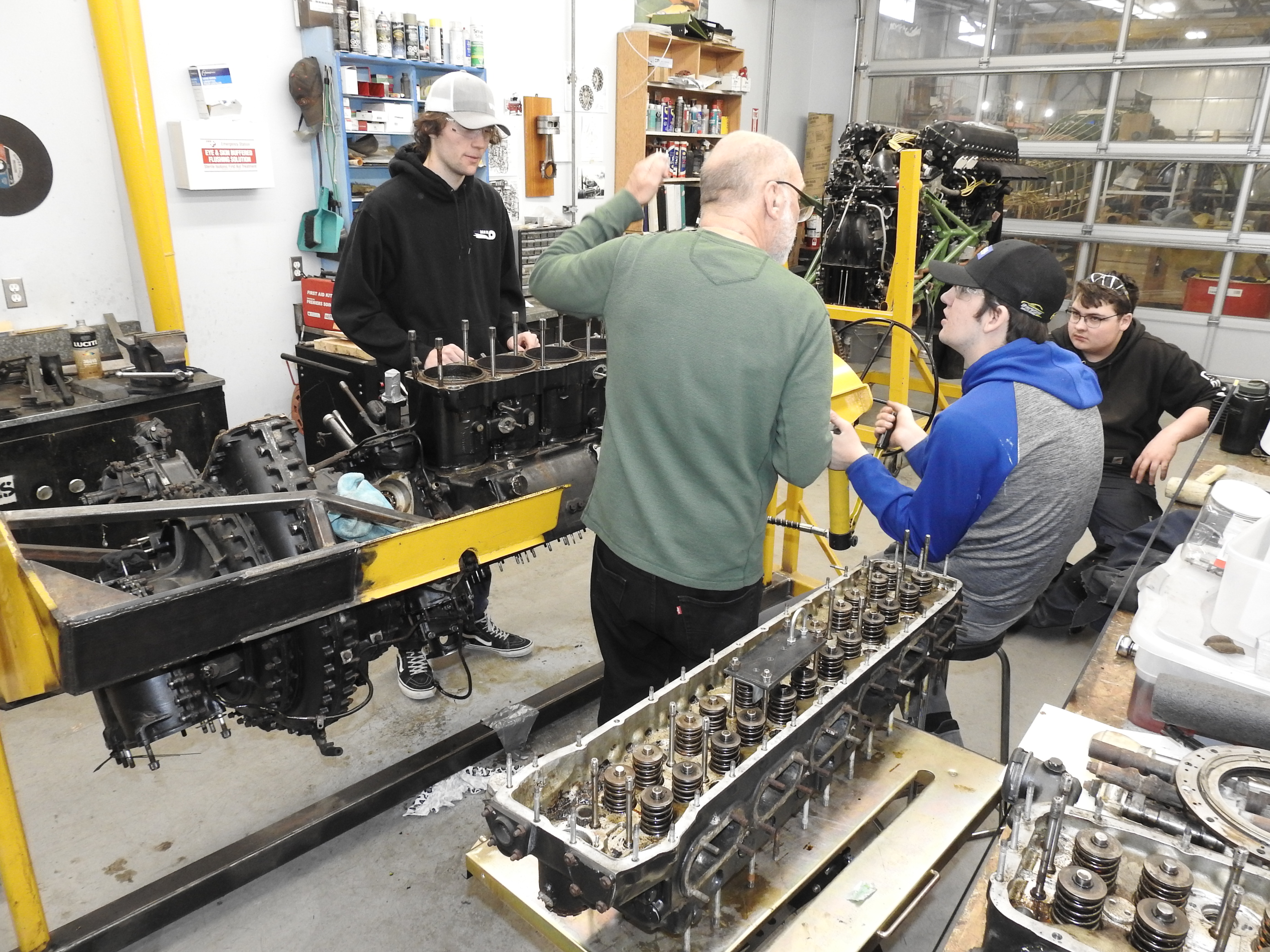
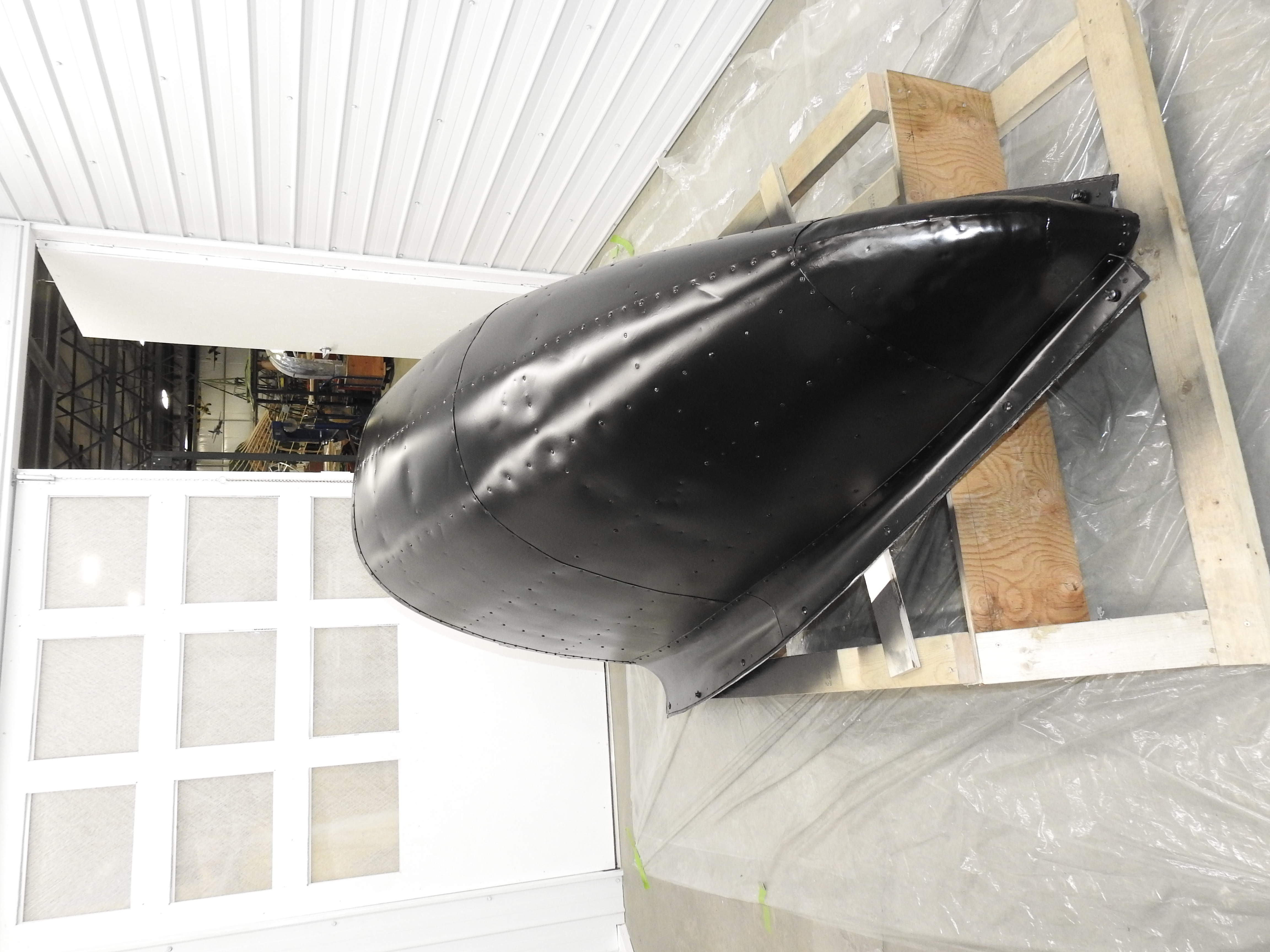
Jack M. provides a little direction to Andrew and Matthew S. and Zach M. on the museum’s Merlin 68 project. Below, the Lanc rear nacelle which we painted for the museum.
Outside of Saturdays at the museum, I manage to keep myself busy chasing parts and technologies we can use like hard chroming, seal manufacturing or alternates that may require things like 3d printing.
Events and Miscellaneous
Lots on the go beyond restoration work this quarter. As is legally required, we held our Annual General Meeting on March 11 via the magic of the Zoom platform, with 21 members attending from as far away as Malaysia. All went well with the usual financial report, elections (sort of) and wrapping up with a PowerPoint illustrating our activities of the past year. The 'sort of' component to the elections simply means that all board members have chosen to remain for another year and that there were no additions to the leadership crew.
Our friends at the AGLC have slotted us in for another fundraising casino, with this year's scheduled for August 21 and 22. The last one netted us just $5 shy of $85,000.
The largest vintage aviation publication in Britain, AEROPLANE magazine, has been following our project closely over the years and have asked for photos and restoration update reports on a regular basis, often giving us generous 2-page spreads nearly every year. As part of our latest report to them, we included the fact that former Spartan camera operator, Roger Tessier stopped by last June after his son John was touring the shop and spotted a picture of 'dad', back in the day, climbing into a Spartan Mosquito.
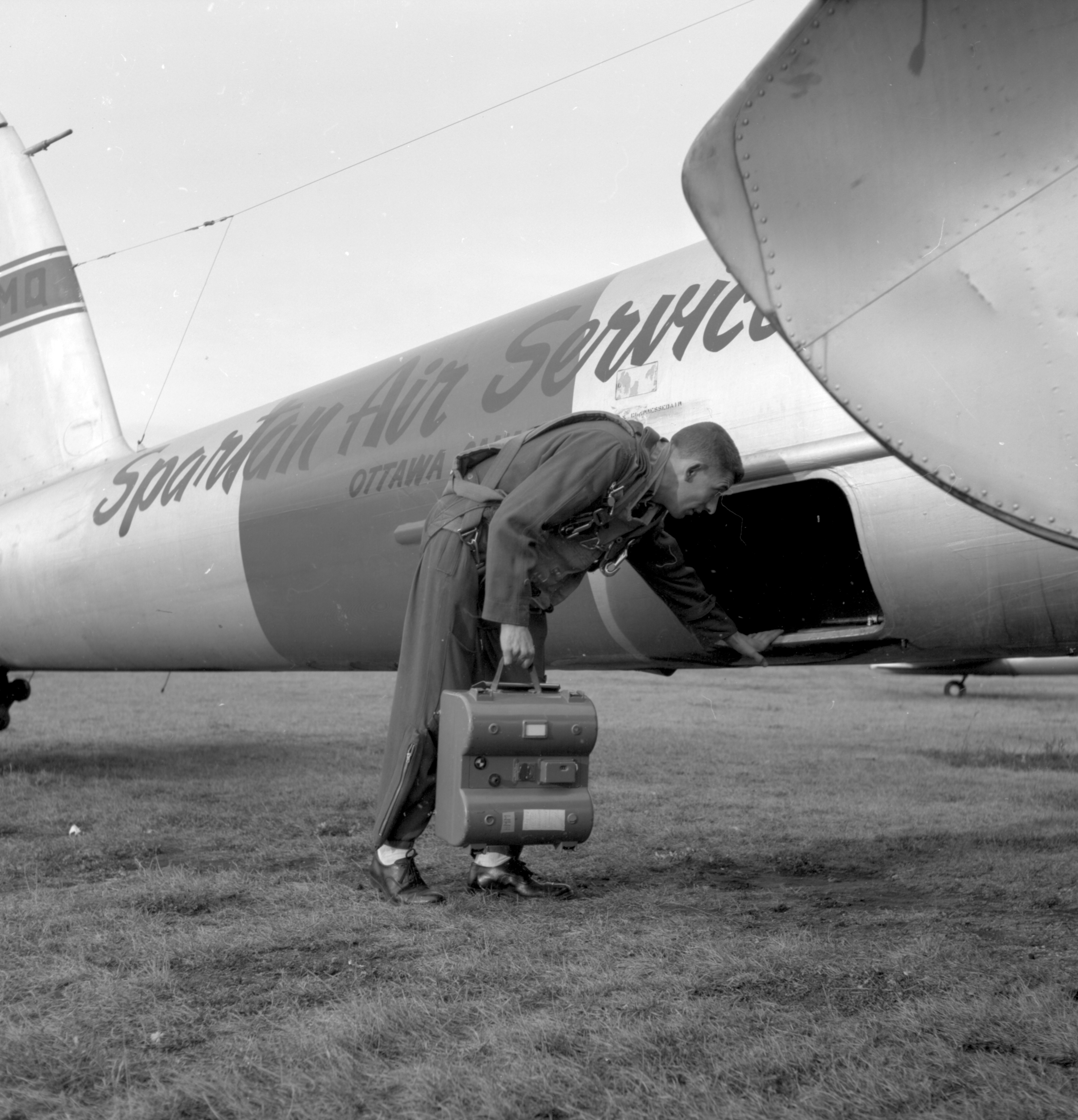
Roger Tessier, camera operator for Spartan Air Services, holding a spare film magazine about to enter his 'office', circa 1957. Roger’s son John, while visiting the shop spotted a copy of this picture taped to our airplane. In June 2025, he brought his father to see the airplane and the story inspired AEROPLANE magazine to ask for a lengthy article about Spartan and Roger’s time with them.
The editor of AEROPLANE halted the restoration update report in favour of an in-depth article about Roger's days with Spartan and a deep backgrounder on the history of Spartan's use of the Mosquitoes for photo-mapping. We agreed and have been asked to get them 5000 words (10 pages), with accompanying photos, by the end of May for publication later this year.
Our hosts at the Bomber Command Museum have chosen Saturday, July 18 as the date for Mosquito Celebration Day this year. Mark thy calendars accordingly. Thanks to Ashley at Bomber Command for the lovely poster:
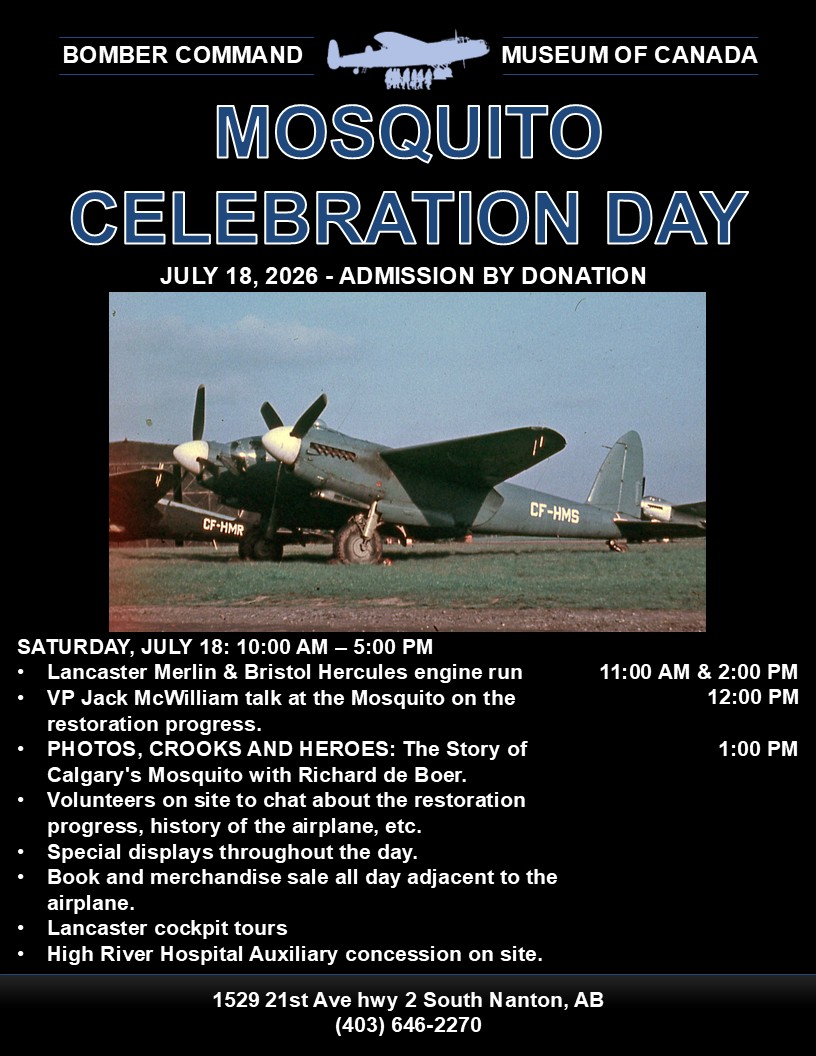
The first engine run and event day at the Bomber Command Museum is May 16th with both afternoon and evening engine runs. The day is themed to celebrate their 40th anniversary.
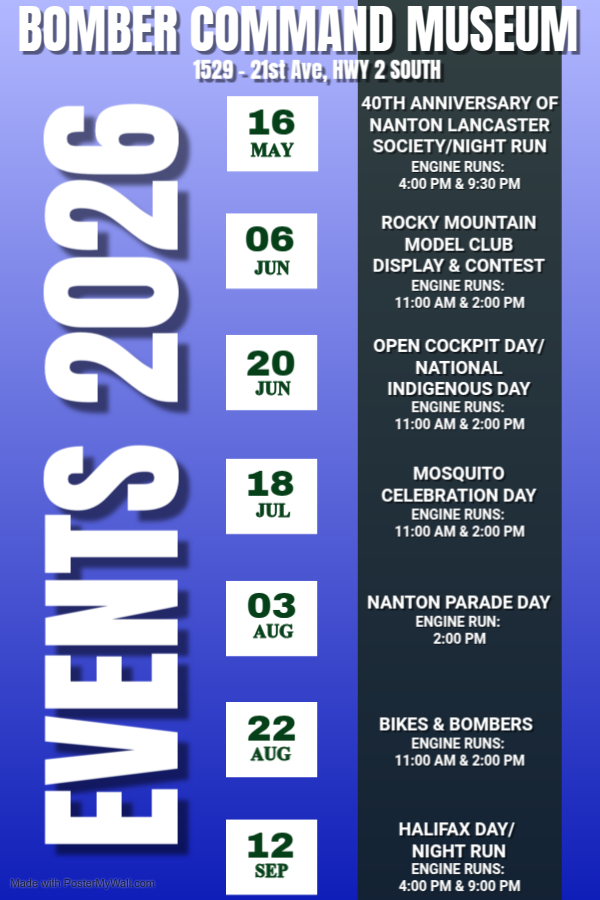
Other events for the year are listed above.
Bring on the Spring!

Richard de Boer, President
April 10, 2026

Website - Calgary Mosquito Aircraft Society